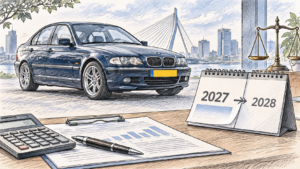
The Dutch youngtimer tax scheme for company cars is set to become more restrictive in the coming years. Under the Tax Plan 2027 adopted by the House of Representatives, the age threshold will increase to 17 years in 2027 and then to 20 years from 2028.
The scheme will therefore become less generous, although the transition is more gradual than originally proposed. The initial plan was to raise the threshold directly to 25 years from 2027.
How does the youngtimer scheme work?
For a company car that is also used privately, the taxable benefit is normally calculated on the vehicle’s original list price.
Older cars can qualify for the youngtimer scheme. In 2026, this applies to cars that are at least 16 years old. The taxable benefit is then 35% of the vehicle’s current market value.
Because the current market value of an older car is often considerably lower than its original list price, the scheme can be fiscally attractive.
New age thresholds
If the legislation becomes final, the following thresholds will apply:
- 2026: at least 16 years;
- 2027: at least 17 years;
- from 2028: at least 20 years.
Transitional rules are expected to apply to certain cars that already fall within the scheme.
The financial impact can be significant
A car that no longer meets the new age threshold may fall back under the regular taxable-benefit rules. This can result in a substantial increase in the taxable benefit.
For example, assume a car originally had a list price of €60,000 and now has a current market value of €12,000. Under the youngtimer scheme, the annual taxable benefit would be:
35% of €12,000 = €4,200.
With a regular taxable benefit of 22% calculated on a €60,000 list price, the amount would be €13,200.
The difference can therefore be substantial.
What should business owners check?
Business owners and employers using an older company car should consider:
- checking the vehicle’s date of first registration;
- determining when the car reaches the new age threshold;
- checking whether transitional rules apply;
- properly documenting the vehicle’s current market value;
- reassessing before 2028 whether keeping the car in the business remains attractive.
For entrepreneurs subject to Dutch personal income tax, the legislative change may also be a reason to investigate whether an earlier classification of the car as business assets can be reconsidered.
Not yet final
The House of Representatives has adopted the Tax Plan 2027, but the package still has to be considered by the Senate.
The changes are therefore not yet final. Nevertheless, entrepreneurs who use the youngtimer scheme can already take the higher age thresholds into account when making future decisions about their company car.