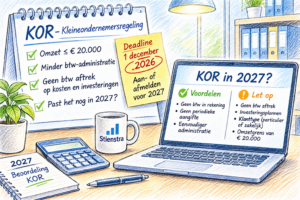
Entrepreneurs who want to use the Dutch small businesses scheme (KOR) from the first quarter of 2027, or who want to leave the scheme, will soon need to make a decision. The Dutch Tax Administration needs time to process an application or withdrawal. A change taking effect on 1 January 2027 therefore requires action by early December at the latest.
The KOR can significantly simplify VAT administration, but it is not financially attractive for every small business. A fresh assessment is particularly sensible where substantial investments are planned, most customers are businesses, or turnover is close to the €20,000 threshold.
Who can participate in the KOR?
The KOR is intended for entrepreneurs established in the Netherlands with limited turnover.
An important condition is that turnover does not exceed €20,000 per calendar year. Both the calendar year in which participation starts and the preceding calendar year are relevant.
If an entrepreneur has several VAT sub-numbers within the same business, the turnover from those activities must be combined.
What does participation in the KOR mean?
An entrepreneur participating in the KOR generally does not charge VAT to customers and normally no longer has to submit periodic VAT returns.
In return, the entrepreneur is also not entitled to deduct VAT on business expenses and investments.
This can have a significant financial impact. An entrepreneur planning to purchase a company car, equipment, inventory or another major business asset may lose a substantial amount of deductible VAT by participating in the KOR.
Turnover below €20,000 does not automatically make the KOR advantageous
Low turnover therefore does not automatically mean that the KOR is the best choice.
For businesses mainly supplying private consumers, the KOR can be attractive. The VAT saving may allow the entrepreneur to offer a lower price or retain a higher margin.
For businesses mainly supplying other VAT-registered businesses, the benefit is often smaller. Business customers can usually deduct VAT charged on a normal invoice, while an entrepreneur using the KOR can no longer recover input VAT on their own costs.
Relevant factors therefore include:
- expected turnover in 2027;
- the type of customers: private consumers or businesses;
- the level of business expenses;
- planned investments;
- the amount of administrative work saved;
- possible VAT adjustment relating to earlier investments.
Monitor the €20,000 turnover threshold
Entrepreneurs already using the KOR must continue to monitor their turnover throughout the year.
As soon as turnover in a calendar year exceeds €20,000, the KOR ceases to apply immediately. The transaction that causes the threshold to be exceeded is itself no longer covered by the exemption.
From that point onwards, VAT must again be charged on taxable supplies.
Careful turnover monitoring is therefore particularly important for businesses operating close to the €20,000 threshold.
Voluntarily leaving the KOR
An entrepreneur may also voluntarily withdraw from the scheme.
A voluntary withdrawal takes effect on the first day of a VAT return period. The Dutch Tax Administration asks entrepreneurs to submit the withdrawal at least four weeks before the desired effective date.
After leaving the scheme, an entrepreneur cannot immediately opt back into the KOR. An exclusion period applies for the remainder of the calendar year in which participation ends and for the following calendar year.
A decision to leave the scheme should therefore not be based only on the short-term impact.
Joining the KOR for 2027: do not wait until the last moment
A new application must also reach the Dutch Tax Administration at least four weeks before the desired start date.
For quarterly VAT filers, the Dutch Tax Administration states 3 December 2026 as the latest date for participation to start on 1 January 2027. The Netherlands Chamber of Commerce (KVK) uses 1 December as a practical deadline for joining or leaving the scheme for the first quarter.
It is therefore sensible to complete the assessment well before December.
Be aware of VAT adjustment rules
Participation in the KOR may also trigger an adjustment of VAT deducted in earlier years.
This can apply to investment goods on which VAT was previously deducted. If participation in the KOR changes the use of an asset from VAT-taxable to exempt use, part of the VAT previously deducted may have to be repaid.
For entrepreneurs who have made substantial recent investments, this is an important part of the calculation.
What should entrepreneurs review now?
Entrepreneurs with turnover close to or below €20,000 should reassess before December 2026 whether the KOR remains suitable for 2027.
- actual turnover for 2026;
- expected turnover for 2027;
- planned investments and the related VAT;
- the proportion of private and business customers;
- possible VAT adjustments on earlier investments;
- whether existing KOR participants may exceed the turnover threshold;
- whether an application or withdrawal must be submitted to the Dutch Tax Administration in time.
The KOR can be administratively attractive, but the best choice depends on the entrepreneur’s specific circumstances. A short financial comparison before year-end can therefore make a significant difference.
Sources: Dutch Tax Administration – Small Businesses Scheme (KOR), Conditions for participation in the Small Businesses Scheme, Applying for the KOR and Withdrawing from the KOR; Netherlands Chamber of Commerce – Important dates for entrepreneurs.